


About The Malahat Review

Name Acknowledgement & the Malahat Nation

When The Malahat Review was founded in 1967 at the University of Victoria, the name “Malahat” was taken and used without consultation, permission, or acknowledgment. In response to our desire to make right this wrong, the Malahat Nation has graciously offered the words that follow.

Malahat Nation is part of the W̱SÁNEĆ People, one of five Nations with deep roots along the lands and waters of southern Vancouver Island. Our people speak SENĆOŦEN, hul’q’umi’num’, and Samish—traditional languages that carry our teachings, stories, and responsibilities.* We are a Coast Salish Nation, living and working together as we walk forward in a good way.

Our traditional territory stretches from what is now called Victoria up past Mill Bay, reaching westward beyond Shawnigan Lake, and north along the W̱SÁNEĆ Peninsula into the Gulf Islands. Our harvesting and kinship ties connect us further, to the Fraser River and down into Washington State. Malahat reserves rest along the Saanich Inlet, beneath YOS (the mountain also known as the Malahat), one of our most sacred places. This mountain and the lands around it remind us that sovereignty is not only about borders, but also our responsibilities to care for the land, water, and all beings who live here.

We stand proud on our hwulmuhw mustimuhw tumuhw (ancestral land of Malahat People), guided by the wisdom of our s’ul’eluhws (Elders) and carried forward by the strength of our stl’ul’iqulh (children). Our inherent rights and title come from generations of stewardship. Fishing, hunting, gathering, and ceremony are part of the seasonal cycles that continue to shape our way of life. Place names such as W̱ȾAWIEM (Hatch Point), SHNI’HA’PUT (McKenzie Bight), and XÍXÍṮEM (McCurdy Point) are reminders that these teachings are written on the land itself.

The name “Malahat” (MÁLEXEŁ, me’luxulh, ma’7lexelh) means “caterpillars.” This name speaks to our relationship with the land, with its beings, and with the cycles of life. Over time, settlers expanded the use of the word to cover the whole west side of the inlet and the mountain, but its meaning remains tied to our people.

Moving Beyond Acknowledgements for Deeper Reconciliation Action

Malahat Nation continues to walk forward in the teachings of our ancestors—building community and governance in a way that honours our Elders, uplifts our youth, and protects the land and waters for generations to come.

Malahat Nation, through the ȾELEṈ Initiative, invites you to join us in our walk of stewardship and reconciliation. The ȾEX̱NÁLEṈ Initiative provides one avenue through which monetary contributions may be made to Malahat Nation to acknowledge and reciprocate the on‐going stewardship responsibilities that Malahat carries so that we can all continue to enjoy the gifts of these lands. For more information on the ȾEX̱NÁLEṈ Initiative, reach out to: lands@malahatnation.com.

Donate to the ȾEX̱NÁLEṈ Initiative:
https://malahatnation.com/news/malahat-nation-exnalen-initiative


Malahat Nation is not affiliated with nor endorses any content included in The Malahat Review. The Nation has been engaged with the magazine on the name of the magazine itself and is open to the magazine continuing to use the name.

* The translations provided in these paragraphs are presented in the following order: SENĆOŦEN, hul’q’umi’num’, and Samish. If a translation is provided singular, it is hul’q’umi’num’.

********************************************************************************

We at The Malahat Review acknowledge and respect the Malahat Nation and express our deep gratitude to them for engaging in a good way with the magazine as we take steps towards being accountable for our actions and relationships.

We acknowledge and respect the Ləʷəŋən (Songhees and Xʷsepsəm/ Esquimalt) Peoples on whose territory the University of Victoria stands, and the Ləʷəŋən and W̱SÁNEĆ Peoples whose historical relationships with the land continue to this day.

We acknowledge that we are uninvited guests on the territory of the Coast and Straits Salish Peoples, who have since time immemorial been stewards of these lands and waters and all the beings who live here.

Mandate

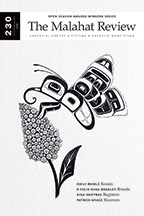
The Malahat Review, established in 1967, is among Canada’s leading literary journals. Published quarterly, it features contemporary Canadian and international works of poetry, fiction, and creative nonfiction as well as reviews of recently published Canadian poetry, fiction, and literary nonfiction. On occasion, it also publishes interviews, essays, and issues on a single theme or author, such as P.K. Page (No. 117), Reviewing (No. 144), Robin Skelton (No. 160), The Green Imagination (No. 165), Lorna Crozier, Patrick Lane, and Aesthetic Kinship (No. 170), Essential East Coast Writing (No. 180), At Home in Translation (No. 188), Mapping Creative Nonfiction in Canada (No. 193), Indigenous Perspectives (No. 197), The Victoria Issue (No. 200), and Queer Perspectives (No. 205).

History

The Malahat Review was established in 1967 by University of Victoria English professors Robin Skelton and John Peter. Thereafter, editors have included Constance Rooke, Derk Wynand, Marlene Cookshaw, and John Barton. Micaela Maftei served as interim editor from January to July 2018. Iain Higgins is the current editor (as of July 2018).

Malahat originally bore the subtitle “An International Magazine of Life and Letters,” reflecting the founding editors’ background in European literature and connections in the international literary community. Under succeeding editors and in step with the growing of a truly national literature, the journal became more strongly Canadian, with a focus on Canadian and international poetry, fiction, and creative nonfiction rather than belles lettres and critical work.

Malahat Origins

Previous work study student Karyn Wisselink studied the Malahat's brief history of internationalism, namely, founder Robin Skelton's literary philosophies.

Read her essay here.

Editorial Vision

The Malahat Review is dedicated to excellence in writing. Its aim is to discover the most promising of the new writers and publish their work alongside the best established writers, to present work accurately and attractively to readers, and to increase awareness of Canadian writing in general through perceptive critical comment.

The vision for the journal is determined by the editor, while submissions are selected by the editor and the editorial board. An advisory board, composed of members drawn from the Victoria writing and academic communities, supports and oversees the magazine in the fulfillment of its editorial mandate.